
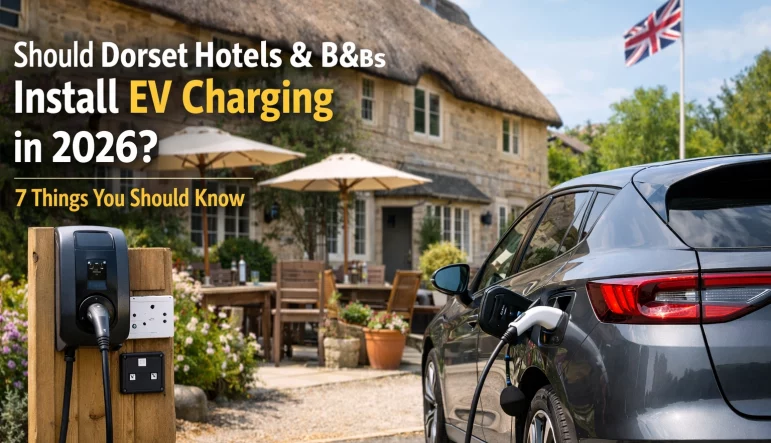
Electric vehicle adoption is accelerating across the UK, and hospitality businesses in Dorset, Hampshire, and Wiltshire are facing a straightforward question: should you install EV charging facilities at your hotel or B&B?
After more than 20 years working with commercial clients across the South of England, we've seen how early infrastructure decisions can position businesses ahead of market trends. The short answer is yes: but with careful planning. Here are seven essential considerations for hotel and B&B owners evaluating EV charging installation in 2026.
The UK government's 2035 ban on new petrol and diesel vehicle sales is driving a fundamental shift in the automotive market. EV ownership isn't a future trend: it's current reality. Across Dorset and the surrounding counties, we're installing home chargers for an increasing number of residential clients, and that translates directly to your guest demographic.
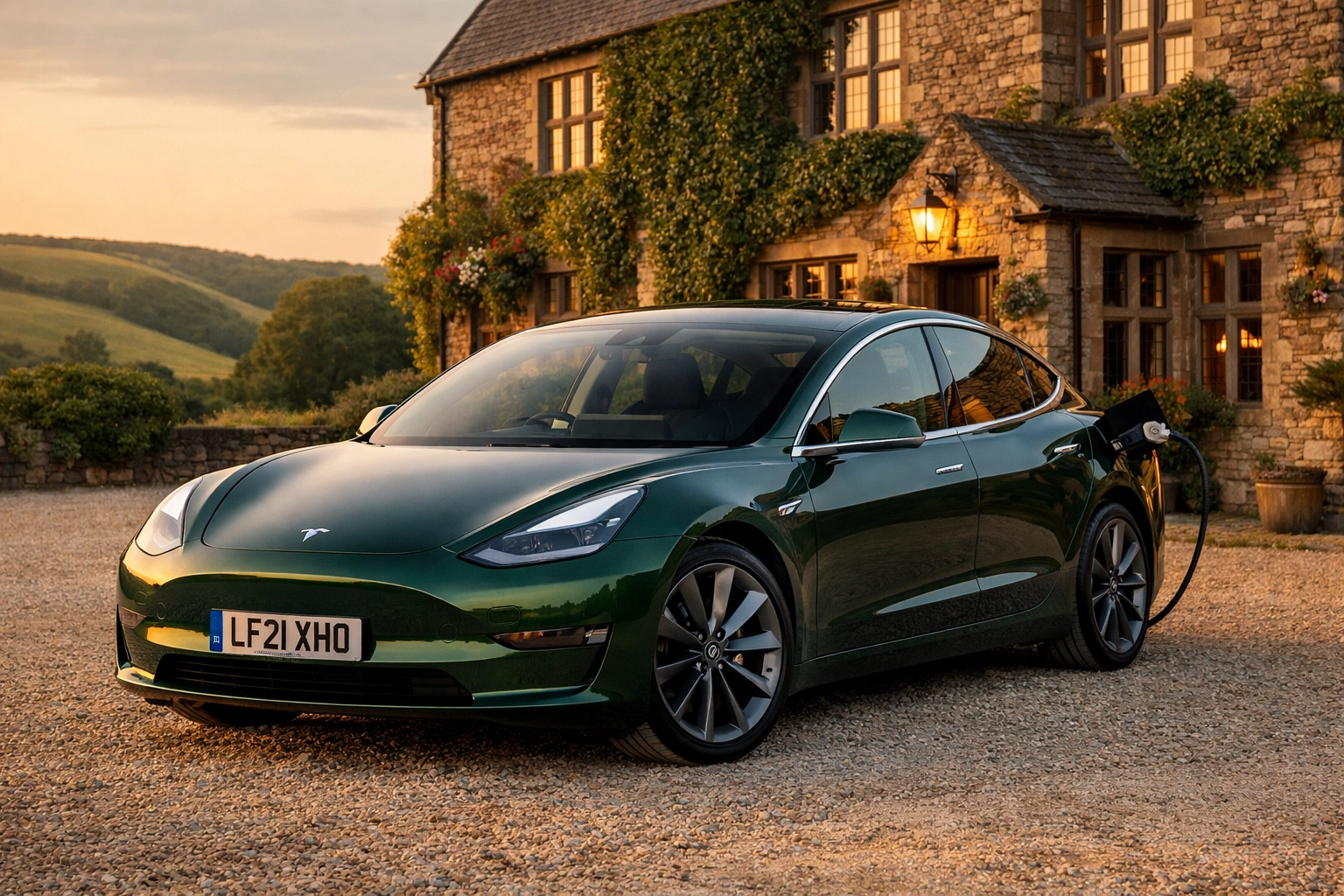
When EV drivers plan overnight stays or extended breaks, charging availability influences booking decisions. Hotels that offer charging facilities remove a significant barrier for these guests. Major chains have recognized this: Premier Inn, for example, has rolled out high-powered chargers across their UK network through the GeniePoint partnership. Independent hotels and B&Bs can gain competitive advantage by offering similar amenities without waiting for corporate mandates.
The question isn't whether your guests will arrive in electric vehicles, but how many will, and how soon. Based on installation trends we're seeing as electricians in Dorset and the wider region, that number is growing month-on-month.
Dorset Council's "Charging Ahead" initiative aims to bring the total number of public charging points to nearly 300 by the end of 2025, with a goal of placing 80% of households within a 10-minute walk of a public charger by 2030. This expanding infrastructure reduces pressure on hotels to serve as the sole charging provider in an area.
However, public charging networks focus primarily on residential areas and town centres. Rural hotels, coastal B&Bs, and properties in less densely populated areas of Dorset still face infrastructure gaps. If your business operates outside Bournemouth, Poole, or Weymouth's urban cores, on-site charging becomes a more significant competitive differentiator.
Additionally, public charging availability doesn't eliminate guest preference for convenient, on-site charging while they sleep or dine. The convenience factor alone justifies installation for many hospitality businesses.
Technical specifications matter when selecting EV charging equipment. For hotels and B&Bs, 22 kW dual-socket fast chargers represent the optimal balance between charging speed and guest needs.
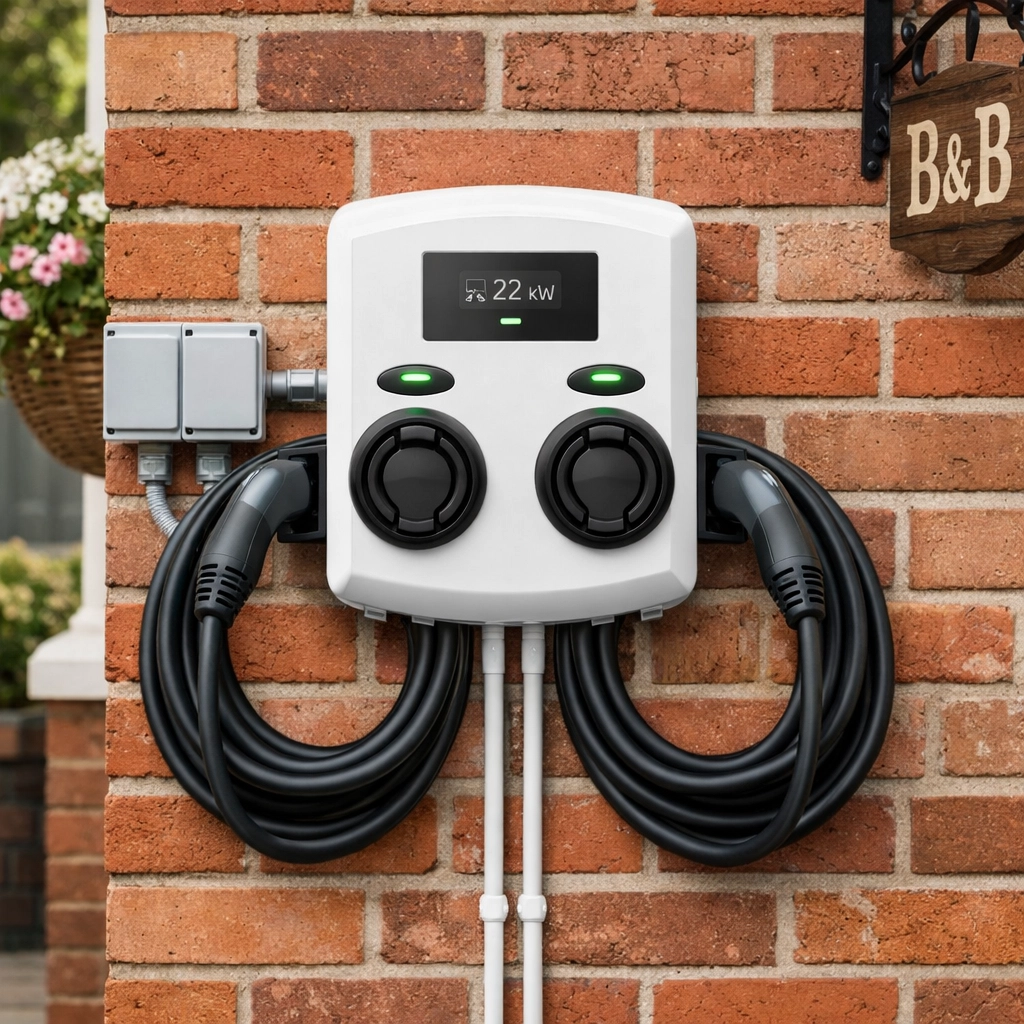
These units typically charge most electric vehicles in 2-4 hours, which aligns with typical guest behaviour patterns: dinner service, overnight stays, or afternoon events. Rapid chargers (50 kW and above) are unnecessary for destination locations where vehicles remain parked for extended periods, and they significantly increase installation costs and electrical infrastructure requirements.
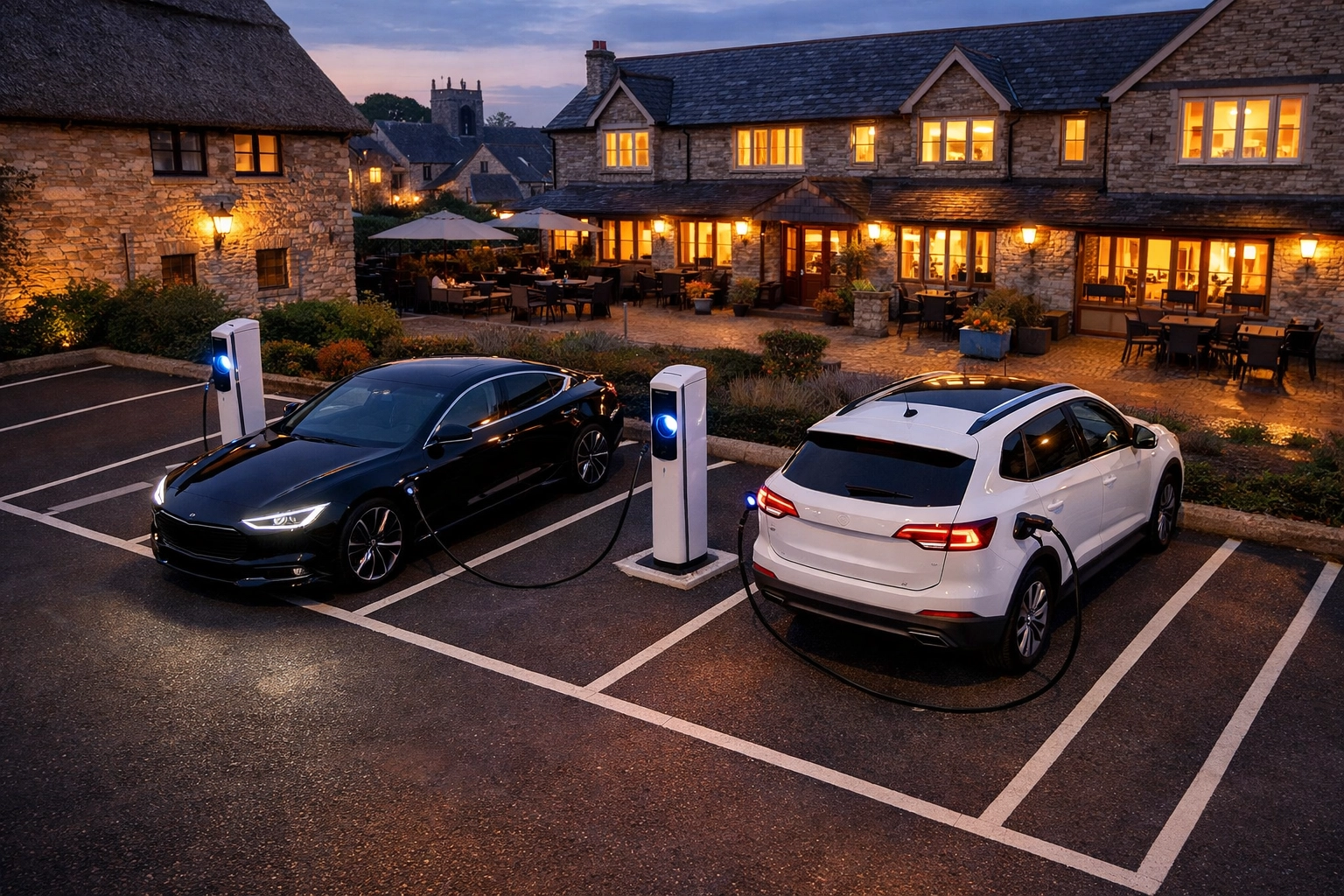
As experienced electricians in Bournemouth and across Dorset, we typically recommend dual-socket units for hotels with multiple parking spaces. This allows two guests to charge simultaneously, maximising the return on your infrastructure investment without requiring multiple expensive installations.
Load management systems can be integrated to balance electrical demand across multiple chargers, preventing issues with your building's overall electrical capacity: a critical consideration for older properties or listed buildings common throughout Dorset's hospitality sector.
Business models for EV charging at hotels generally fall into three categories: free amenity, cost-recovery charging, or profit-generating service. Each approach has merit depending on your business model and target market.
Many hotels currently offer free EV charging as a value-added amenity, particularly at higher-end establishments where it reinforces brand positioning around sustainability and modern convenience. For boutique B&Bs and country hotels targeting environmentally conscious guests, free charging can be a powerful marketing differentiator.
Cost-recovery models charge guests the actual cost of electricity consumed, typically through RFID cards or mobile apps. This approach works well for longer stays where charging costs become material.
Profit-generating models charge above cost, creating a modest revenue stream. However, this requires more sophisticated billing infrastructure and may deter some guests when free alternatives exist nearby.
From a pure cost perspective, charging an electric vehicle remains significantly cheaper than refuelling petrol or diesel vehicles, so even paid charging represents value for guests. The electricity cost to fully charge most EVs ranges from £8-15, depending on vehicle size and electricity rates.
Every property presents unique electrical infrastructure challenges. The installation process for a modern hotel with recent electrical upgrades differs dramatically from a Georgian country house operating as a B&B.
Key technical factors include:
Electrical supply capacity: Your existing main electrical supply must handle additional load from EV chargers. Properties with three-phase supplies generally accommodate charging infrastructure more easily. Single-phase supplies may require upgrades, particularly for multiple charging points.
Cable routing: Distance between your main distribution board and parking areas affects installation costs. Listed buildings or properties with heritage restrictions face additional complexity.
Civil works: Groundworks for cable ducting, mounting posts for chargers, and weather protection all factor into project scope and cost.
Future scalability: Installing ducting and infrastructure for future expansion during initial installation saves significant costs compared to retrofitting later.
Working with experienced electricians in Poole, Bournemouth, or your specific Dorset location ensures compliance with BS 7671 wiring regulations and building regulations. Commercial EV charging installations require proper certification and testing: this isn't a DIY project or a job for non-specialists.
Government initiatives and local authority programs can significantly reduce upfront installation costs for commercial EV charging. While specific programs evolve, the principle of public-private partnership in charging infrastructure remains consistent.
Dorset Council has funded on-street and public car park charging through government grants, private investment, and developer contributions. While hotel installations differ from public infrastructure, investigating available grant programs with your local authority or through the Office for Zero Emission Vehicles (OZEV) can reveal cost-sharing opportunities.
The Workplace Charging Scheme historically provided grants for businesses installing charging points for staff and fleet vehicles, though eligibility criteria change. Hotels and B&Bs may qualify under certain circumstances, particularly if installations serve dual purposes.
Local business support programs in Dorset occasionally include sustainability initiatives that could encompass EV charging infrastructure. Worth investigating through your local council or tourism partnership.
Beyond grants, tax implications merit consideration. Capital allowances and energy-efficient equipment tax relief programs have historically applied to EV charging infrastructure. Consult with your accountant to understand current provisions.
Hospitality is fundamentally about meeting guest expectations before they become demands. Hotels and B&Bs that install EV charging in 2026 position themselves ahead of the curve, not catching up with competitors.
Marketing advantages include:
Search visibility: Guests specifically search for "hotels with EV charging" when planning trips. Listing your charging facilities on booking platforms, Google Business Profile, and your website captures this search traffic.
Sustainability credentials: EV charging demonstrates environmental commitment: increasingly important to guests across all demographics, not just EV owners.
Partnership opportunities: Some EV manufacturers and charging networks offer co-marketing opportunities for businesses that install their equipment.
Local distinction: In many Dorset towns and villages, you may be the first hospitality business offering charging, creating a clear differentiator.
Future-proofing: Infrastructure installed now serves your business for the next decade-plus, avoiding emergency installations when demand becomes overwhelming.
As electricians in Dorset with over 20 years of experience working with commercial clients, we've observed that businesses making proactive infrastructure investments consistently outperform those reacting to immediate pressure. EV charging falls squarely into this category.
EV charging installation represents a moderate capital investment with long-term strategic value for Dorset hotels and B&Bs. The business case strengthens for properties in rural locations, those targeting environmentally conscious guests, and establishments competing directly with national chains already offering charging facilities.
Technical complexity requires working with qualified, experienced electrical contractors familiar with commercial installations and local building requirements across Dorset, Hampshire, and Wiltshire. Proper planning accounts for current needs while building scalability for future expansion as EV adoption continues growing.
The hospitality sector moves quickly. Guest expectations established by large chains rapidly become baseline assumptions across all accommodation providers. Installing EV charging in 2026 positions your business proactively rather than reactively( always the preferable position in competitive markets.)