
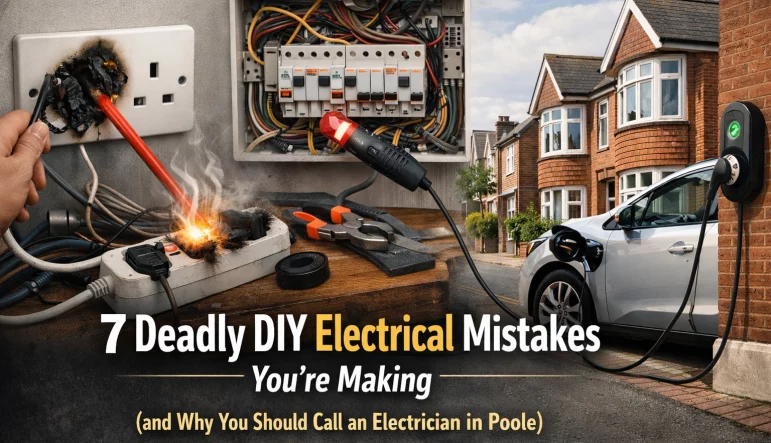
Home improvement projects are a common sight across Dorset, especially with the rise of online tutorials promising easy fixes for complex household problems. For many homeowners in Poole, Bournemouth, and the surrounding areas, the appeal of "doing it yourself" is driven by the desire to save money and the satisfaction of maintaining a home. However, when it comes to your electrical system, the line between a successful project and a life-threatening disaster is incredibly thin.
At Dorset Electrical Solutions Ltd, we frequently encounter the aftermath of DIY attempts that have gone wrong. While painting a wall or fixing a shelf is relatively low risk, tinkering with wiring without the proper training is a different matter entirely. Electrical work requires a deep understanding of physics, building regulations, and safety protocols. Mistakes in this field do not just lead to a crooked shelf; they lead to house fires, severe injuries, and legal complications.
Here are the seven most common and deadly DIY electrical mistakes we see across the region, and why they should be left to a professional electrician in Poole.
The most immediate danger of any DIY electrical project is the risk of electrocution. Many homeowners assume that simply flicking a wall switch to the "off" position is enough to make a circuit safe. This is a fatal misconception. Unless the power is isolated at the consumer unit (fuse box) and the circuit is verified as dead using a calibrated voltage tester, there is a high risk of encountering live current.
Even a standard 230V UK domestic supply is more than enough to disrupt the human heart’s rhythm, leading to cardiac arrest. Professional electricians follow a strict "Safe Isolation" procedure. We use insulated tools and specialized testing equipment to ensure no current is flowing before we touch a wire. If you find yourself in a situation where a DIY project has caused a power failure or a "tripped" switch that won't reset, you should contact an emergency electrician Bournemouth immediately rather than attempting to force the system back on.

Choosing the wrong wire for a circuit is a classic DIY error. In the UK, different circuits require specific wire thicknesses (measured in mm²) to handle the electrical load safely. For instance, lighting circuits typically use 1.5mm² cable, while socket circuits usually require 2.5mm² Twin and Earth. High-draw appliances, such as electric showers or ovens, require much thicker cabling, often 6mm² or 10mm².
When a DIYer uses a wire that is too thin for the current passing through it, the wire encounters high resistance. This resistance generates heat. Over time, the heat melts the plastic insulation, exposing live copper and potentially igniting nearby building materials or insulation. Our team often finds melted cables hidden behind walls during kitchen modernisation projects where homeowners have attempted to add extra sockets using substandard wiring.
Electrical current needs a solid, continuous path to flow safely. One of the most common causes of house fires in Dorset is "arcing." Arcing occurs when electricity is forced to jump across a gap in a loose or poorly made connection. This creates an intense heat source: essentially a miniature lightning bolt inside your wall: that can reach temperatures high enough to start a fire.
DIYers often fail to tighten terminal screws sufficiently or use the wrong connectors for the job. We also see many instances of "over-stripping" wires, where too much copper is exposed outside of the terminal, or "under-stripping," where the screw is tightened onto the plastic insulation rather than the copper itself. Both scenarios are dangerous. Ensuring secure, tight, and correctly stripped connections is a fundamental part of what our electricians Poole provide.

With the increasing number of gadgets and appliances in modern homes, it is tempting to simply "spur off" an existing socket to add more outlets. However, every circuit in your home is designed with a maximum capacity. Overloading a circuit by adding too many points or using high-wattage appliances on a circuit not designed for them puts immense strain on the consumer unit and the cabling.
This is particularly common during home office setups or when installing residential audio visual systems. While an extension lead might seem like a quick fix, "daisy-chaining" multiple leads together is a significant fire hazard. If you find that your breakers are tripping frequently, it is a sign that your system is over-capacity and needs a professional assessment from an electrician Dorset.
Cables are often tucked away in lofts, under floorboards, or behind plasterboard. During DIY renovations, these cables are frequently damaged by nails, screws, or even heavy footsteps. A small nick in the insulation might not cause an immediate failure, but it creates a localized weak point.
Furthermore, we see many DIY installations where cables are run through sharp metal studs or over rough joists without proper protection (like grommets or conduit). Over time, the vibration of the house or thermal expansion causes the insulation to rub away, leading to a short circuit. Professional installation ensures that cables are routed through "safe zones" and protected from mechanical damage, keeping your home compliant and safe.

Earthing is the most critical safety feature of your home's electrical system. It provides a safe path for fault current to travel back to the ground, triggering the fuse or RCD to cut the power instantly. Without proper earthing, any metal part of an appliance or a light fitting could become live during a fault. If you touch that metal surface, your body becomes the path to the ground, resulting in a severe electric shock.
Many DIYers, especially when changing light fittings or switches, fail to reconnect the earth wire properly or assume it isn't necessary for "minor" changes. This is a deadly mistake. Our team at Dorset Electrical Solutions Ltd verifies the continuity of the earth path during every job to ensure that safety mechanisms will actually work when needed.
A common DIY trap is the "make-do" approach with tools. Using a kitchen knife to strip wire instead of a dedicated wire stripper can nick the copper core, reducing its current-carrying capacity and making it prone to snapping. Using a standard screwdriver on specialized electrical terminals can strip the screw heads, making it impossible to tighten the connection properly.
Perhaps most dangerous is the lack of a proper, calibrated multi-meter or voltage indicator. Relying on a "neon screwdriver" or a cheap non-contact voltage tester can be misleading, as these tools can sometimes give false negatives or fail to detect certain types of faults. Our electricians Bournemouth use professional-grade, regularly calibrated testing equipment to provide 100% certainty regarding the state of your wiring.

Beyond the physical dangers, there are significant legal and financial risks to DIY electrical work. In the UK, most electrical work in homes must comply with "Part P" of the Building Regulations. This means that significant works: such as installing new circuits, working in "special locations" like bathrooms, or replacing a consumer unit: must be notified to Local Authority Building Control.
If you perform this work yourself without the proper certification:
It is always better to be safe than sorry. While changing a lightbulb or plugging in a new appliance is perfectly fine, any work involving the permanent wiring of your home should be handled by a qualified professional. We provide a full range of services across Dorset, Hampshire, and Wiltshire, ensuring your home remains safe and efficient.
Whether you are looking for audio visual installation Bournemouth or need a full rewire of a property in Poole, our team has the expertise to get the job done right the first time. We also offer advice on money-saving electrical tips, such as LED lighting upgrades and smart thermostats, which can lower your bills while increasing safety.
For more information on our services or to view our previous work, you can visit our gallery or check our blog for more safety tips.
Electrical safety is not a place for guesswork. If you are unsure about any aspect of your home's electrics, or if you have a DIY project that has gone off the rails, give us a call. We are your local, professional electricians poole and we are here to help.
Thanks – The team at Dorset Electrical Solutions Ltd