
Unit 6 Cobham Business Centre, Cobham Road, Ferndown Industrial Estate, Wimborne, Dorset BH21 7BX
Mon–Fri 08:00 AM – 05:00 PM
5.0 ★★★★★ on Google Reviews
Post Image
01 Jun, 2026
Posted by Kaine O'keeffe
0 comment

The Homeowner’s Guide to Safer Evenings in Bournemouth: Consumer Unit Upgrades, Smoke Alarms, and PIV Ventilation

Evenings are when homes in Bournemouth and Poole put the most demand on electrics. Lighting, cooking, showers, chargers, portable heaters, and entertainment kit all run at the same time. If the consumer unit is dated, the alarms are basic, or the property has ongoing condensation, it’s easy to end up with repeat tripping, nuisance alarms, or damp that never really clears.

This guide covers three practical upgrades that reduce risk and improve day-to-day reliability: consumer unit upgrades, proper smoke/heat/CO alarm coverage, and positive input ventilation (PIV). It also includes a simple evening checklist that homeowners and landlords can follow. Service areas referenced here include Dorset, Bournemouth, Poole, Ferndown, and Ringwood.

Internal links for context:


1) Consumer unit upgrades (fuse board replacements) in Bournemouth, Poole, Ferndown, and Ringwood

A consumer unit upgrade is usually the biggest single improvement to electrical safety in a typical Dorset home, especially where the property still has an older fuse box, a split-load arrangement that trips frequently, or minimal RCD coverage.

From a BS 7671 (18th Edition) perspective, modern boards are typically built around:

  • Metal enclosure (non-combustible) for domestic consumer units
  • RCBO protection on circuits (common best-practice approach on upgrades)
  • SPD (surge protection device) where required, unless a risk assessment supports omission
  • Clear circuit identification and test results on completion

Common signs a homeowner in Bournemouth or Poole should at least discuss a board upgrade with an electrician:

  • Older rewireable fuses or cartridge fuses
  • Regular tripping when a kettle, shower, EV charger, dryer, or portable heater is used
  • Buzzing, heat, or discolouration around the board
  • DIY additions over time (mixed accessories, spur-on-spur, unclear circuit labelling)
  • No recent inspection history (often paired with “it’s been fine for years”)

A consumer unit upgrade should be paired with a wider view of the installation. If the earthing and bonding are not right, or if test results show issues on circuits, simply swapping the board isn’t the whole job. In practice, many homeowners start with an EICR and then decide whether remediation plus a consumer unit upgrade is the sensible route for the property.

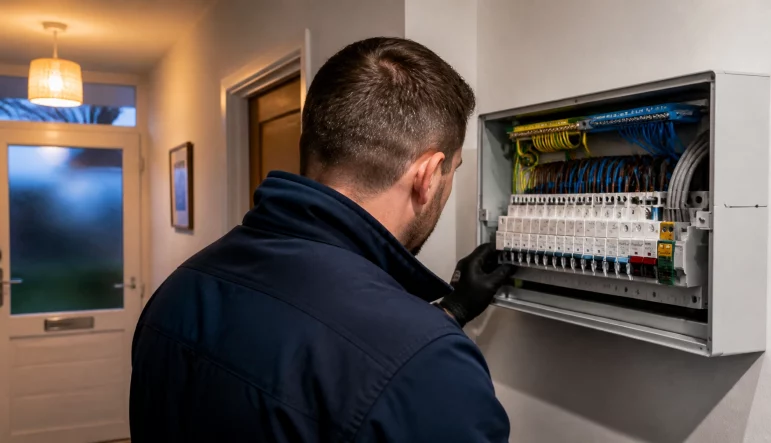
Close-up of a modern metal consumer unit with RCBOs and surge protection

References:


2) Smoke alarms, heat alarms, and CO alarms: what “good” looks like for safer nights

Smoke detection is most valuable at night because early warning is the point. If alarms are missing, poorly located, or not interlinked, a small incident can become a major one before anyone wakes up.

There are two things to keep straight:

  • Legal minimums (especially relevant for landlords)
  • Best-practice design (commonly aligned with BS 5839-6 categories like LD2/LD3 in domestic settings)

For many homes in Dorset, a sensible target layout looks like:

  • Smoke alarms on circulation spaces (hallways/landings)
  • A heat alarm in the kitchen (to reduce false alarms)
  • Additional smoke detection in key habitable rooms depending on layout
  • Interlinking so activation in one area sounds across the property (wired or radio)

For landlords in England, the Smoke and Carbon Monoxide Alarm (Amendment) Regulations 2022 set baseline requirements (smoke alarms on each storey, and CO alarms in rooms with fixed combustion appliances excluding gas cookers). Many landlords in Bournemouth and Poole go beyond the minimum and fit interlinked mains alarms because it reduces complaint call-outs and improves coverage.

Evening-focused maintenance that actually gets done:

  • Test alarms monthly (test button)
  • Replace units at end-of-life (commonly 10 years; check the device marking)
  • Don’t “temporarily” remove batteries to stop nuisance alarms; address the cause (often positioning, cooking fumes, or the wrong alarm type in the kitchen)

Interlinked smoke alarm in a hallway with a kitchen heat alarm in the background

Relevant service link:


3) Positive Input Ventilation (PIV) in coastal Dorset homes: what it is, and common PIV myths

Condensation is a repeating theme in Bournemouth and Poole housing stock, particularly in:

  • Older terraces and semis with mixed upgrades
  • Flats with limited purge ventilation
  • “Improved” properties with double glazing and added insulation but unchanged ventilation
  • Homes drying laundry indoors and running bathrooms/kitchens heavily in the evenings

Positive input ventilation is a whole-house approach. A PIV unit (commonly loft-mounted in houses) supplies a continuous, low-rate flow of filtered air and creates a slight positive pressure. That pressure helps move humid air out via background leakage points, trickle vents, and normal extract routes.

What Dorset Electrical Solutions installs for PIV work:

Common PIV myths (and the practical version):

  • Myth: “PIV is the same as a dehumidifier.”
    PIV does not collect water. It changes the moisture balance by air change and dilution.
  • Myth: “PIV fixes every damp problem.”
    PIV is for condensation/humidity issues. Penetrating damp, roof leaks, guttering, or bridging need building repairs.
  • Myth: “PIV replaces bathroom and kitchen extract fans.”
    PIV is background ventilation. Local extract still matters (especially evenings).
  • Myth: “PIV will definitely make the house freezing.”
    Poorly planned airflow can feel draughty. Correct sizing, diffuser placement, and the property’s general airtightness makes the difference. Many installs are “fit and forget” once set correctly.

If the main concern is mould around windows and external corners, a PIV install is usually paired with:

  • Checking existing bathroom/kitchen extract operation
  • Confirming trickle vents are functional (and used)
  • Basic moisture source control (evening cooking, lids on pans, drying habits)

Loft-installed positive input ventilation unit with insulated ducting


4) Evening electrical safety checklist (Bournemouth + Poole edition)

This is aimed at the stuff that tends to happen after 6pm when the house is busy. It’s also relevant for landlords doing routine checks between tenancies.

Consumer unit / protection

  • Press the RCD test button at the interval stated on the device guidance (IET consumer guidance indicates testing at a maximum interval of 6 months).
  • If an RCD/RCBO won’t reset, don’t keep forcing it back on.

Heating and high-load appliances

  • Avoid running multiple high-load items together on questionable circuits (portable heaters + tumble dryer + cooker is a common trigger for nuisance trips).
  • Don’t plug portable heaters into multiway adapters.
  • Keep heaters away from curtains and soft furnishings.

Sockets, plugs, and extensions

  • Check for hot faceplates, buzzing, scorch marks, loose plugs, or intermittent power.
  • Avoid daisy-chaining extension leads.
  • Don’t run leads under rugs where they can be damaged or overheat.

Lighting

  • Persistent flicker can be a lamp issue, but it can also be a loose connection.
  • Outdoor fittings should be appropriate IP rating and correctly sealed (especially in coastal air).

Alarms

  • Ensure smoke/heat/CO alarms are in place and powered.
  • Replace end-of-life alarms rather than waiting for a failure.

Ventilation

  • Use kitchen and bathroom extraction during and after use.
  • If condensation is regular by evening, consider a ventilation assessment (PIV is one option, not the only one).

5) Quick note for commercial premises: pubs, restaurants, B&Bs, offices

Safer evenings are not just a domestic issue. Bournemouth and Poole hospitality venues tend to load up circuits in the evening with:

  • Kitchen equipment
  • Bar and cellar equipment
  • External/signage lighting
  • CCTV, access control, Wi-Fi, POS, and AV
  • Emergency lighting and fire alarm systems that must remain compliant

For commercial clients, the same themes apply but with a compliance and continuity angle:

Unbranded electrician van parked on a residential street in Poole in the early evening


Local coverage and standards (kept simple)

Dorset Electrical Solutions operates across Dorset, Hampshire, and Wiltshire, including Bournemouth, Poole, Ferndown, and Ringwood (and surrounding areas). Electrical work is carried out by qualified electricians working to BS 7671 requirements where applicable, and certification is provided for notifiable work and tested installations as required.

Locations reference:

Keywords included naturally in context: electricians in dorset, positive input ventilation, electrical safety poole.


FAQs (quick answers)

Do older fuse boxes automatically mean a house is unsafe?
Not automatically, but they often mean reduced protection and unclear fault isolation. An EICR is the normal starting point if the condition is unknown.

Are interlinked smoke alarms worth it in a standard home?
Yes, especially for night-time warning. Interlinking avoids the “alarm is going off downstairs but nobody hears it upstairs” problem.

Is PIV a good idea in Bournemouth and Poole?
Often, yes, where the issue is condensation and poor background ventilation. It is not a fix for leaks or building defects.

How often should RCDs be tested?
Follow device guidance. IET consumer guidance indicates testing at a maximum interval of six months using the test button.

Leave a Comment

Your email address will not be published.*